

How to Make Ham Stock





Learning How to Make Ham Stock is a great way to add flavor to soup or stew recipes where you’re using ham! And ham stock is made with trimmings you might normally throw in the trash. Here are all my tips, plus recipe ideas for using the stock once you make some.
PIN tips for making Ham Stock to try it later!
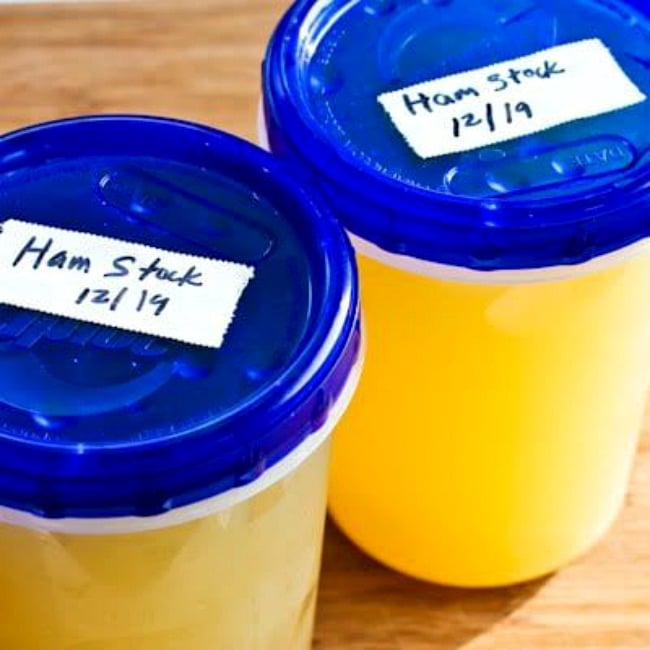
This post shows How to Make Ham Stock, but first let me confess I’m not always the most frugal cook! But one thrifty habit I have is saving scraps of meat and vegetables and making homemade stock. Making stock from things that might have been thrown away feels like getting free food! Plus the homemade stock is so much more flavorful than canned stock, and your house smells great while it’s cooking.
If you’re already making stock from chicken, turkey, or beef, you may not need this tutorial on making stock from ham. But when I mention ham stock to people, I’m been surprised how many people have never heard of it. So save those scraps of ham rind and leftover small pieces of ham in the freezer and make some ham stock!
Email This Recipe To Me!
What ingredients do you need?
(This is only a list of ingredients; please scroll down for complete printable recipe. Or if you use the JUMP TO RECIPE link at the top of the page, it will take you directly to the complete recipe with ingredient amounts.)
- ham scraps, including the rind from the ham
- ham bones, if available
- celery scraps, including the leaves and root end of the celery
- carrot scraps, including the carrot tops but not the leaves
- onions scraps or several onions, peeled and cut in half
- water
- ham flavor base (optional), I love Goya Ham Flavor Concentrate (affiliate link)
Why Make Ham Stock?
Saving scraps of ham (and vegetables) in the freezer and then making ham stock is a great money-saving habit. And the homemade ham stock adds amazing flavor to soup, stew, or any recipe made with ham that uses broth.
Is Ham stock low in carbs?
It’s impossible to completely calculate nutritional information for a recipe that doesn’t have specific ingredients. But I do feel confident saying ham stock is low-carb, keto, gluten-free, dairy-free, and fine for the original South Beach Diet.
Recipes where you could use ham stock to replace some of the liquid.
- Slow Cooker Cabbage Soup with Ham
- Instant Pot Split Pea Soup
- Ham and Cabbage Soup
- Anasazi Bean Soup (Slow Cooker or Stovetop)
- Hopping John Soup
- Slow Cooker Bean Soup (with Ham, Spinach, and Thyme)
- White Bean Soup with Ham
How to Make Ham Stock
Save scraps of ham and vegetables and simmer them together to make delicious ham stock to use in soup or stew recipes, for an extra boost of ham flavor!
Ingredients
- ham scraps, including the rind from the ham
- ham bones, if available
- celery scraps, including the leaves and root end of the celery
- carrot scraps, including the carrot tops but not the leaves
- onions scraps or several onions, peeled and cut in half
- 12 cups water (or more if you have a really large stock pot)
- ham flavor base (optional)
Instructions
- Save scraps of ham or ham bones in the freezer until you have enough to make stock. (I usually try to have at least 4 cups of scraps for a very large soup pot, but you don't have to have quite that much. You can also freeze scraps of celery, onion, and carrots if you have leftovers.
- Use the largest soup pot you have for making stock. Put the ham scraps into the pot along with pieces of onion, celery, and carrots, and fill the pot with water. (I use vegetable scraps equivalent to about 2 onions, 3-4 carrots, and 3-4 large celery stalks.) You can add some coarse ground pepper or a few peppercorns, but DO NOT ADD SALT!
- Turn the pot on to the lowest possible simmer and let the stock cook for 6-8 hours, adding a cup or two of water about once an hour.
- If you want to cook this when you won't be home, it can be done in a large slow cooker, but you will need to reduce the stock on the stove after it simmers all day in the slow cooker.
- After 6-8 hours, remove the ham pieces and vegetables with a Slotted Spoon (affiliate link) or large spoon and discard.
- Taste the stock (carefully, since it's hot!) If the flavor is not as strong as you'd like, turn the heat to medium and boil gently for 30 minutes or more until some of the water is boiled away. (I nearly always need to do this.)
- I like to use a ham flavor base to make the stock more intensely ham flavored, and Goya Ham Flavor Concentrate (affiliate link) is my favorite product of this type.
- If you have a fine mesh stock skimmer (affiliate link) that's a good way to skim off any scum that rises to the top while the stock is cooking.
- When the stock has concentrated enough to have a rich ham flavor, strain again, using the finest strainer you have. I use a fine mesh Yogurt Strainer (affiliate link) and strain the stock into a Fat Separator (affiliate link) which lets the stock pour from the bottom, leaving the fat to be discarded. You can also strain through cheesecloth if you don't have a strainer.
- If you don't have a way to remove the fat, you can let the stock cool in the refrigerator and the fat will harden on top and can be scooped off.
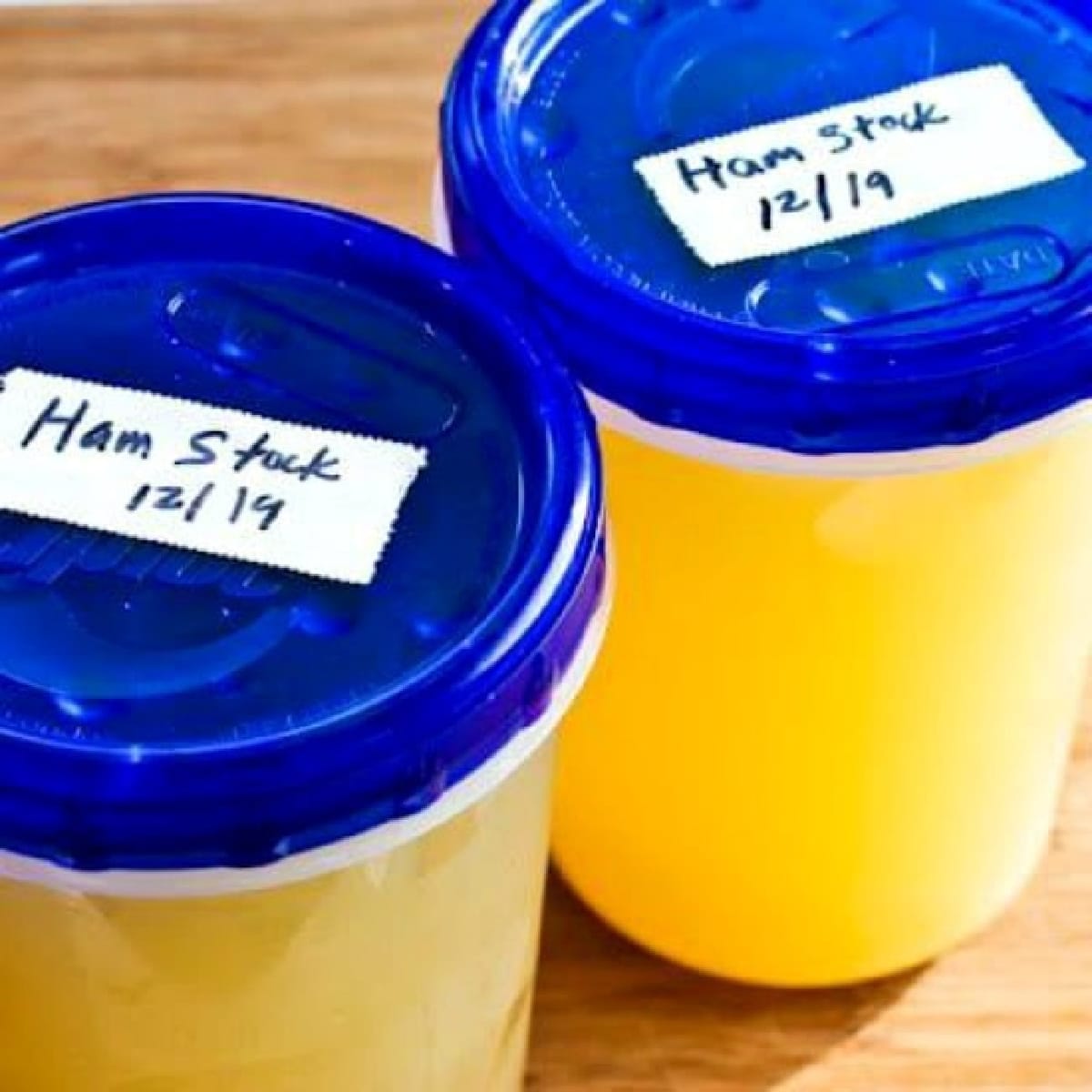
- I like to freeze the stock in 2 cup or 4 cup containers so I know exactly how much I have when I'm thawing it for a recipe, but you can use any plastic container with a tight fitting lid. I use adhesive tape and a sharpie market to label stock with the type and date. Stock can be stored frozen for 6-12 months, although I never manage to keep it in the freezer for that long!
- And as you can see from the photos in this post, I've been making ham stock using this method for a very long time!
Notes
Ham stock is relatively low in carbs, calories, and fat. It does have some sodium.
This method of using ham and vegetable scraps to make ham stock has been used by Kalyn for more than 30 years!
Low-Carb Diet / Low-Glycemic Diet / South Beach Diet Suggestions:
Homemade ham stock will always be relatively low in carbs, calories, and fat, and could be as a soup ingredient for low-carb or Keto diets or for the original South Beach Diet. It does have some sodium, and if you’re combining it with purchased chicken broth you might want to use a low-sodium broth.
Find More Recipes Like This One:
Use the Diet Type Index to find recipes suitable for a specific eating plan. You might also like to follow Kalyn’s Kitchen on Pinterest, on Facebook, on Instagram, on TikTok, or on YouTube to see all the good recipes I’m sharing there.
Historical Notes for this Recipe:
In 2019 Kalyn’s Kitchen was moved to a new blogging platform, so it’s now impossible to see the earliest date on this post. But the first comment is from 2010, and I’m sure I had been making ham stock for years by then! The recipe was last updated with more information in 2026.


43 Comments on “How to Make Ham Stock”
Can I use just the bone? I want to use the rest of the ham in a soup. Should I just go straight to the soup?
If you don’t have a lot of other ham scraps (pieces you wouldn’t use in the soup) I would probably just put the bone in the soup when you make it.
I used my ham bone to make “ham beans” (really just the ham bone with attached meat, chicken broth, and beans cooked in the crock pot all day). Can I re-use the bare bones for anything, or just let them go, since they’ve been cooked twice already? Thanks!
I doubt they have much flavor left in them after that. But I bet your beans are tasty!
How long can I keep ham stock in the fridge?
Truthfully I am not sure since I always freeze it and just thaw right before I use it. I'm thinking it won't keep more than a few days.
This may be very good. I am not disputing that. However, it is NOT ham stock. It is ham and vegetable stock. Ham stock is the juices that come from baking ham. I save these juices and use them for flavoring black eyed peas, green beans etc. I have used these juices for years and now that I have been diagnosed with type 2 diabetes I need to know the nutritional values of them. All I can find, over and over again, is ham juices that have been tainted with vegetables and called ham stock. Does no one but me use the pure juices?
I guess not. Meat simmered with vegetables to make a broth used for cooking is commonly called stock. I don't know what the liquid that comes out of the ham is called, maybe ham juice?
When I google ham stock, I find lots of recipes like mine, so maybe there are two things with the same name. Sorry, but I don't have the nutritional info.
It is called ham stock. All of my friends and family that have shared their cooking expertise with me all through my life have called it ham stock. I never heard of tainting it with vegetables until I started trying to find its nutritional value. Can someone please help me with carb grams, fat grams and calories of this pure ham juice/stock/broth?
Dictionary dot com states:
“Stock is a mixture of boiled or simmered ingredients that typically include animal bones, meats, vegetables, and possibly a small amount of salt. Stocks are often used as a base for foods such as soups, stews, sauces, and gravies.” It goes on to explain that stock is made from meat bones whereas broth is made from the meat itself.
Food Network explains:
“Stock is made by simmering bones, herbs, aromatics and regular mirepoix (a combination of onions, carrots and celery) or white mirepoix (onions, fennel, leeks and celery) in water for several hours. As they cook, the bones release gelatin which creates body and rich flavor and mouthfeel. Roasting the bones before making stock is optional, but makes for a richer, darker broth. Stock is a key ingredient for making soups, stews, sauces and gravies, and can also add flavor when used to cook beans, rice, pasta or grains.
Broth, on the other hand, relies primarily on meat (i.e. chicken, beef, shellfish) for flavoring, simmers for less time, contains a slightly less robust flavor and usually has more sodium.”
So you may want to share with all of your friends and family that have shared their cooking expertise with you all through your life that according to culinary professionals (and in fact the rest of the world), stock is typically made with vegetables. Even bone broth is typically flavored with (sorry; “tainted” by) a mirepoix. But hey, you do you! Feel free to make a one-dimensional, flavorless stock using just meat bones and water. You can even insist that what the rest of the world calls stock isn’t stock, just like you can insist that the earth is flat (like your “stock”.)
P.S.-since there are negligible amounts of carbs in what the entire world defines as stock (like one gram per serving), and since meat is typically carb free, I would suggest there are probably no carbs in what you consider to be stock.
Excellent Blog!
I love ham stock and the recipes you listed.
Ham and cabbage soup will be made here tomorrow.
Thanks
Thanks Tony, glad you like it!
Dave, glad you like the idea, hope you enjoy!
Easter is this weekend and I've bought a small ham on the bone for leftovers and soup (I'm not hosting Easter this year, but I still want some leftovers and the bone). The idea of making stock out of the scraps and bone never crossed my mind. I think that's a fantastic idea, since I make home-made stock all the time and I may get more use out of it, than batch of soup.
Madeline, I haven't tried that. but it does sound easy!
Kalyn – have you ever tried making it in a slow cooker? Oh my gosh, it is so easy. You just throw it all in there and let it cook overnight and into the next day, then strain. So easy peasy and there doesn't seem to be as much fat.
Yes, I would cook the beans part way before adding the ham bone.
G'morning Kalyn: I have the remains of a shank ham. Reading your site has given me ideas for making stock in the future. I want to remove any remaining slices of ham from and use the bone to flavor some lima beans. Would I add the shank AFTER the beans are almost done (so that the ham is still flavorable?)
Thank you
Denise
I don't like to eat a lot of saturated fat. I know people have different opinions about that, so if you don't mind the fat, just don't strain the stock.
Why would you remove the fat?
Just what I was looking for, thank you!
Oh that sounds so delicious. Too bad I had already thrown out the veggie scraps. But I will know for next time. I've never made stock before and just started making soup. So this will be great to have around when I decide to make that special soup! Yum!
I think the peanut soup sounds absolutely fantastic!
Peanut Soup! It's great. Ham stock with bits of onion, celery and carrot, all cooked very soft, then add peanut butter and a bit of cream, season with pepper (ham will make salty broth) and serve in small cups (it's very rich) garnished with crushed peanuts. Yum!
David, I agree! Ham stock is a magical ingredient.
There's nothing better than Lentil Soup/Stew made with homemade ham stock. Just throw in the veggie triumvirate of diced carrots, onions and celery and some herbs and a bay leaf or two and you're golden.
Oh, the aroma that you receive when making ham stock should be made into a woman's perfume product. She'd have to beat 'em off with that ham bone. 🙂
Hi Kalyn, sorry i dont have an account on here. Saw your recipe and I like the bit about keeping the scraps only thing i would say is that you have to boil down the stock to get the flavour but you top up the water during cooking. If you didnt top up with water you might not have to boil it down
I really like the sound of a ham stock. It would just be packed with flavour!
Great idea! I'm a big fan of making my own chicken stock, but ham stock never occurred to me. I have a ham bone left over in the freezer from Christmas, so I'll have to give this a try!
One tip I picked up from Michael Ruhlman is to simmer stock in a low oven, set to 180*F to 200*F, instead of on the stovetop.
Mike V @ DadCooksDinner
Jennifer, glad I can give you a new idea!
Vivari, I love the Ziploc Twist-n-Loc Containers. Now my store also has a no-name brand of these, which are also good. I love the way the lid twists on to keep things airtight.
Flying Roo, I think parmesan rinds would be lovely in this.
Mmmm…mmm…mmm, ham stock, who would have thought?!
I'm thinking of throwing in the parmesan rinds that I save for wedding soups 🙂
your containers looks nice. r they ziploc
vivari
Oh my, as soon as I saw your post tile, I thought: 'Why didn't I ever think of this". I mean, never thought of making ham stock. Thanks for sharing a great use for all those scraps. Make room in the freezer.
Paula, I just save the veggie scraps in a Ziploc bag, which works because I make stock fairly often. You can only save them a month or two like that, so if you need to freeze longer, I'd use a container.
adding a ham bone to a batch of chicken makes an excellent, tasty addition! Makes great Chicken and egg domburi (Chicken and Egg cooked in stock, soy sauce and rice wine)…
I was just chatting with another blogger about how I should save my scraps to make stock. I love your idea of using containers in the freezer to collect your meat/bone bits. Could you clarify how you hold onto the veggie scraps? Do you freeze those also?
Pam, glad I can give you a new idea!
Year on the Grill, I have to say that moving to the Virgin Islands sounds pretty exciting. Keep us posted on that!
Jenna, as I said I'm not always that frugal, but I do hate to waste things that are useful!
Daisy, glad I could share the idea.
I've made chicken, turkey, and beef stock, but never ham. I'll start saving the scraps next time we cook a ham! I don't have leftover veggies; we have pet rabbits.
I love the idea of saving scraps of veggies for the stock! I never thought of that. I always save bits of bread, ends of the loaf, etc. to use for bread crumbs and to make croutons or stuffing. I should have thought of it. Thanks for the great idea. I have a ham bone I'm going to try it on!
Jenna
Austin, Texas
I am at such an odd place in my life right now, I may be moving to the Virgin Islands in a couple weeks. If so, everything is so expensive there, posts like this will come in very handy.
I always save my ham bone for stock, but I never thought about saving the scraps!